For
Clemente Padin Edgardo Antonio Vigo
is no doubt that every work of art or poem demands audience participation or reader. This phenomenon finds Umberto Eco (1984). If ambiguity, ie, the diversity of meanings in the artwork, is the note that precisely defines its artistic character, then all work is necessarily "open" in the sense that it offers several interpretive options. This is true in all cases as the work remains intact, ie remains the same. This is possible because each interprets according to the sum of knowledge and experience that has, hence the variety of interpretations. Still, Eco himself noted the existence of two types of works. On the one hand there are those that:
.... We proposed an "opening" based on a partnership theoretical, mental user, which should be interpreted as an act of art produced, and organized as a structural full employment (even if it is structured so that it is endlessly interpretable.)
Also there:
... a more restricted category of works which, by their ability to assume different structures physically unrealized unforeseen, could be defined as "works of art"
As we shall see, a good sector experimental poetic production in Latin America, according to this characterization of Eco, fall squarely within the group "works in motion."
CONCRETE POETRY
The origin of this phenomenon came about around 1956 when he made the first exhibition of Concrete Poetry in Sao Paulo and Rio de Janeiro. Three streams converge there explored by Alvaro de Sá: Noigrandes group of St. Paul, known as the structural rigor, the symbolic language of metaphysical Gullar Neoconcretism would lead to the language and mathematical Wlademir spational-Dias-Pino would lead to Semiotic Poem and the Poem / Process. In the last two instances where it is most appealing to the participation of the "reader."
Neoconcretism
Thus for Gullar theorist Neoconcretism, the art object is an entity entelética not materialize as perceived target, a "Nao-object." That is, while the poem is not read or eat, does not exist. Reader participation, in relation to the poem, it is imperative for the purpose of making real communication: this requires the reader to "act" on the text. For this neoconcretism poets as Ferreira-Gullar, Theon Spanudis, Osmar Dillon and others make use of the poems-objects (poems in which there is no substitute support entail the loss of information), objects in the form of books or boxes where the folds, uneven pages, colors, perforations, overlays, etc. act as attenuators / triggers poetic information. So, Ferreira-gull, to arouse the reader's participation as co-manager and updater of the poem and set the time as a privileged life in which it decided the transcendental experience of non-object, is laying the premises of art and poetry of the following years, especially, the trends that would popularize the Conceptualism.
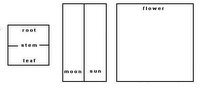 OSMAR DILLON: Unfolding Object-Poem
THE POEM spational
Wlademir Dias-Pino, promoter spational mathematical trend of Concrete Poetry in 1956 and works proposed in this character as the object-poem "A Bird", a book that can "read" if handled, that is, if the "reader "operating in the pages looking for information in the text. This is a poem in which the physicality of paper, its texture, transparency, its accidents (drilling and roughness) and the various possible combinations of the texts inscribed (in the pages flip and exchange) require proactive and attentive reader. Net differences not only points to trends and current Noigrandes Ferreira-Gullar Neoconcrete within Poetry Specifically, to define the poem as a physical entity (not abstract) but also involves a formal progress in expanding the field of reception. That is, requires a real involvement / social (not just abstract / individual) of the receiver.
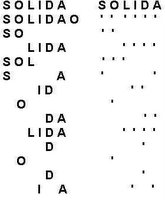
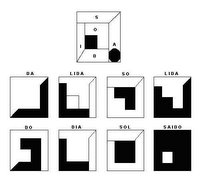 Wlademir Dias-Pino: SOLID, 1956 - SOLID, spatial version, 1962
Almost in the same vein, the poem SOLID, exhibited by Dias-Pino in first exhibition of Concrete Poetry, not only allows for transposition verbal semiotics of signs used in the poem but also invites participation the reader to offer the possibility to recreate the poem according to the system of sign language you want or you can use in your version.
semiotic poem
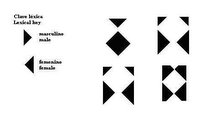 Semiotic Poem: LUIS ANGELO PINTO
SOLID, going to space formulations, opens the door to later developed Semiotic Poem (1962) by himself Dias -Pino and, later, in 1964, São Paulo Decio Pignatari poets and Luis Angelo Pinto (1965). The Semiotic Poem replaces the meanings of words shapes. This will display the corresponding figures with significance set by a "key lexical" or "dictionary" of the proposed new visual language. Configurations or formations of figures are the poems to read.
The next step was to move from its privileged position to verbal language (as the only source of poetic expression) and allow all the languages \u200b\u200b(including verbal language, of course) could take the responsibility. Here too, the participation of the "reader" creative "is decisive. Note in this Poem Semiotic Neide Sá, belonging to the second stage of movement, in which the translator code elements define not only icons but also participate in Text:
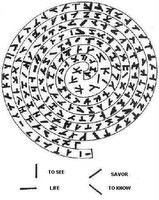 Semiotic Poem: NEIDA SA
one hand indicated the linguistic code imposes some reading, but the reader, to manipulate and alter the orientation of the figures, also alters its significance and therefore the text. On the other hand we can see how certain expressions that have no place in the verbal language, as eg, the word "know", "flavor" and "see" that would give rise to the term "flavor do know" that no specific formulation in verbal language, do have a level of visual language. The meaning of the poem depends on the active participation the "reader."
POEM / PROCESS
By 1967 at the inception of the Epic / development process as natural quasi Semiotic Poem, such participation was officially incorporated range of formal proposals, with the name "version", ie the creation of the poem to the reader operating on the "matrix" or poem draft agreement to their repertoire of knowledge. The release comes as a solution to the consumption of the unique work (an expression of privileges) and allows the "reader" operate on the poem that he proposes creating for itself, different versions. The poet, now, just enough for him, the way architects, describing visually or verbally poem project leaving it to the "reader" to materialize.
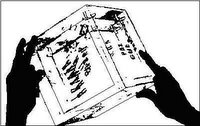 NEIDA SA: Transparencies
Certainly, reading the "project" will generate the "versions" via participation of the "reader", according to materials available in every time and place particular. This frees the poet to "update" the poem without the fear that the new media, which necessarily will discover science and technology, might prevent its realization.
FOR POETRY AND / OR MAKE
These formal developments of Brazilian poetry edge could not fail to exert great influence in all spheres of art, poetry and related disciplines. So in Argentina, Edgardo Antonio Vigo, who, after speaking of the Poem / Process as a "poetry to build", ie, a poetry that requires the participation of the reader but following the outlines of a "programmer" or "projector process, "goes one step further by proposing a program that gives certain instructions (signals or tracks) to the reader and this, the real" constructor of the poem, "who will bring life to the poem. In his own words, "... the possibility of art is not only the participation of the observer but activation constructive. "(1970).
The new" reader "or" true creator "receives a modified project through creative participation. These ideas were embodied in the day on September 30, 1970 in University Hall the Republic, Montevideo, Uruguay, as part of the Vanguard Publishing Exhibition, which was the work of Edgardo Antonio Vigo "poem demagogues." Each participant was given a form with the project to be undertaken:
"Place, talking anonymity, a phrase, phoneme, symbol or visual (etc.) necessary for you in a poem in this space. Make a tube and insert it into the URN No. 1. Receive certification of the vote in the form of a card to be hanging from his lapel. Thanks "
Each participant, upon action on the white form, introduced in a special box with a round hole (not homer as the current polls). The day was completed with the work of Clemente Padin" Poetry must be made by everyone "in which participants acted on a blackboard which hung ribbons and white papers. Each one gave them a circular which stated:
" DIRECTIONS: Type in a verb blank ballot infinitive to express its need for action at this time. Then you nail in the sees fit, so that the verb is hidden by the ribbon. At the end of the poem, the organizers stick horizontally blank ballot so that it can be read, depending the color, and so will the pattern of concern at the collective level and plastic concrete poem, along with others, has contributed to create. "
It not only creates consumer actively according to the project but that does not individually depending on the version that deserves the solitary act of consumption but does so collectively. In the expectation of concrete and Visual Poetry through participation Poem / Process the creative construction of Poem-Making. Modification operating on the mode of artistic production and, consequently, the mode of consumption. "The most profound activation of the individual: the performance by him of the poem." The key proposal is about the modus operandi, the mode of production and consumption, not the work or product, which does not prevent it be altered unpredictably by the mode of production triggered (1971).
It is enlightening to note Vigo Expo / International Proposals to Perform at the Centre for Art and Communication (CAYC) Buenos Aires, Argentina, in 1971:
"The next June 18 will open this exhibition. All those present today whose history of having been made by artists from the field of visual or sound poetry. These two camps have been reactivated constantly searches performed internationally and have dropped (almost entirely) the treatment of poetic and visual level, as well as traditional venues, both in its presentation (exposure) and development (book .) Accumulated experiences and allow them the proposal.
At the time of the liberation of the camps in the traditional arts are divided into genera, but not advocate a total art, research POETIC remain within that field, it comes from all imponderable that indefinable "mysteries to unravel" as well as traits may notice a "contemporary romance" as defined in their form and conjugated differently. The exhibition has been organized by Edgardo Antonio Vigo, with the direct collaboration of Elena Pelli (Resistencia / Chaco) and Clemente Padin (Montevideo / Uruguay RO).
To maintain consistency within the presentations of projects and some of his works have started from the PROCESS / POETRY, movement in Brazil breaks the hegemony that until about 1969, kept the NOIGRANDES GROUP (concrete poetry) in San Pablo. The POETRY / process innovation brings the possibility of active participation of the observer, to those who provide "minimum key" you are welcome and encouraged to shape the final content of the poem partly or proposed. It also adds to this the possibility of a constant change of the result (by the intensification of public and individual participation), it becomes a "NUNCACABAR" of the poem. Later there is a movement across the world, where the poetic investigations are proposed but not realized. It
the possibility of exchanging ideas, concepts and projects and free of the poetic object (dear to the Surrealists with his variation POETRY / objectives and proposals for the first theoretical notes of poetry / process-Wlademir DIAS-PINE-) as the final outcome and necessary so far. The completion of planned work may be made by a wholly away from the developer or researcher. "
this fragment also note Edgardo Antonio Vigo (1971) describing his project A VISUAL WALK TO THE PLAZA RUBEN DARIO:
"A Card indicating a minimum key and an element (which may be substituted), invites us to perform an act that we can simply modify the other. Based on his reading, the realization of our own act. Explain: take a piece of chalk, mark a cross (or any other geometric center or not) within the center or around it to make a 360 º (which may be smaller or plural), add a variant on the horizon, we can change by standing on tiptoe or squatting (why not come down and support our body literally on the floor), with any of these possibilities and exercise You have made VISUAL WALK TO PLAZA RUBEN DARIO (designer : EAV, Buenos Aires, CAYC, 1970). The absence of the work, need not be present, the ephemera of the room, open to the possibility CONSOLIDATED ACTS dissimilar to those proposed makes us all into makers (read traditionally creator) of consumer situations and not typed a priori. "
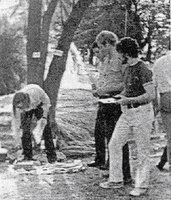 EDGARDO ANTONIO VIGO : "A Walk Along the visual Ruben Dario Plaza, Buenos Aires, 1970.
POETRY INOBJETAL
Clemente Padin's ideas had already materialized in some works published in the magazine OVUM 10, as eg "Gastou, Gastou" and "In Hoc Signo Vinces" in which the reader was urged to act on the poems. Thus, by 1971, made a poetic action which he called Poetry Inobjetal. Please note that in those years (late 60s.) are attending a unanimous questioning the fundamentals of the language, particularly verbal language, which is considered a source of all information deformations via ideology, and another agent system for the subjugation and control of society. So it was not strange that this proposal Padín utopian attempt to set aside the language of "representation" characteristic of the verbal and other languages \u200b\u200bthat their meanings conventionally established by social consensus to propose a language of "action", signs "to act, to say. " That is, proposed to replace the signifiers for the actions and meanings for the consequences of action and senses awakened. Of course, the "makers of texts" in this particular language, for the sake of "doing" would be participating and while creating the "poem of action." The downside of this proposal, as he himself admitted it Padin (1975), is that, for there must be communication languages \u200b\u200band the "actions" had not been inventoried or conventionalized to the point that each of them you could attribute a meaning (except for a small number of which by custom have been given a sense as eg, giving flowers express "love", etc.). In addition, the "readings" of the actions modulated by the degree to which affected the interests of "readers" depending not only on the repertoire of each other, but their expectations social.
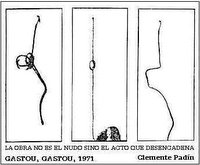 Clemente Padin "Gastou, Gastou" 1971.
POESIA SONORA GESTURAL HYPERTEXT ASSEMBLY AND / OR MAKE
had to wait until 1996 to find "beyond" the proposals to the poetry of the participation of the 60s. we have discussed. The Argentine poet Fabio Doctorovich Paralengua Group of Buenos Aires, applying the dynamics of new media gives the "reader / active participant" to express themselves through different media: sound, gesture, movement, etc. , expanding registration of expressive possibilities. After recognizing the contributions of Vigo and Dias-Pino and analyze the monoconceptualidad of almost all of the poetic production of the century, ie strictly vehicular decoding a single channel by proposing the plurality of ways of expression, the Poem Multiconceptual, as is, moreover, it has assumed experimental poetry today to take advantage of all the dimensions of language, not only the semantic level but also the sound, the visual, performative, etc..
In his theoretical formulation, expressed Doctorovich (1998):
"An application of multi-tenant could be production works to work various components (textual, visual, sound, etc.) separate parts would join interrelated in the manner of a modular structure. Each module, unlike the multimedia or audio would not necessarily be represented simultaneously with others. This would give the character of a modular work "work to build" because the reader could arrange the modules in different sequences possible or add your own modules, creating a multiplicity of readings. In order to ensure that the work is a single (albeit divided) and not the mere sum of its parts, and to address one or more common topics, modules should have parts that work in the manner of interlocking pieces, being the most obvious example of this technique intertext in which the B module would be used phrases that would refer to the module A.
Clemente Padin Edgardo Antonio Vigo
is no doubt that every work of art or poem demands audience participation or reader. This phenomenon finds Umberto Eco (1984). If ambiguity, ie, the diversity of meanings in the artwork, is the note that precisely defines its artistic character, then all work is necessarily "open" in the sense that it offers several interpretive options. This is true in all cases as the work remains intact, ie remains the same. This is possible because each interprets according to the sum of knowledge and experience that has, hence the variety of interpretations. Still, Eco himself noted the existence of two types of works. On the one hand there are those that:
.... We proposed an "opening" based on a partnership theoretical, mental user, which should be interpreted as an act of art produced, and organized as a structural full employment (even if it is structured so that it is endlessly interpretable.)
Also there:
... a more restricted category of works which, by their ability to assume different structures physically unrealized unforeseen, could be defined as "works of art"
As we shall see, a good sector experimental poetic production in Latin America, according to this characterization of Eco, fall squarely within the group "works in motion."
CONCRETE POETRY
The origin of this phenomenon came about around 1956 when he made the first exhibition of Concrete Poetry in Sao Paulo and Rio de Janeiro. Three streams converge there explored by Alvaro de Sá: Noigrandes group of St. Paul, known as the structural rigor, the symbolic language of metaphysical Gullar Neoconcretism would lead to the language and mathematical Wlademir spational-Dias-Pino would lead to Semiotic Poem and the Poem / Process. In the last two instances where it is most appealing to the participation of the "reader."
Neoconcretism
Thus for Gullar theorist Neoconcretism, the art object is an entity entelética not materialize as perceived target, a "Nao-object." That is, while the poem is not read or eat, does not exist. Reader participation, in relation to the poem, it is imperative for the purpose of making real communication: this requires the reader to "act" on the text. For this neoconcretism poets as Ferreira-Gullar, Theon Spanudis, Osmar Dillon and others make use of the poems-objects (poems in which there is no substitute support entail the loss of information), objects in the form of books or boxes where the folds, uneven pages, colors, perforations, overlays, etc. act as attenuators / triggers poetic information. So, Ferreira-gull, to arouse the reader's participation as co-manager and updater of the poem and set the time as a privileged life in which it decided the transcendental experience of non-object, is laying the premises of art and poetry of the following years, especially, the trends that would popularize the Conceptualism.
 OSMAR DILLON: Unfolding Object-Poem
 THE POEM spational
Wlademir Dias-Pino, promoter spational mathematical trend of Concrete Poetry in 1956 and works proposed in this character as the object-poem "A Bird", a book that can "read" if handled, that is, if the "reader "operating in the pages looking for information in the text. This is a poem in which the physicality of paper, its texture, transparency, its accidents (drilling and roughness) and the various possible combinations of the texts inscribed (in the pages flip and exchange) require proactive and attentive reader. Net differences not only points to trends and current Noigrandes Ferreira-Gullar Neoconcrete within Poetry Specifically, to define the poem as a physical entity (not abstract) but also involves a formal progress in expanding the field of reception. That is, requires a real involvement / social (not just abstract / individual) of the receiver.

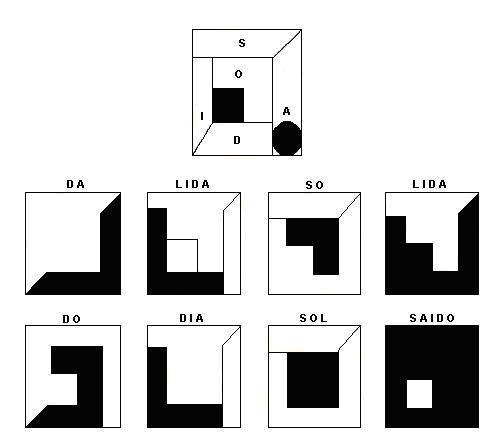 Wlademir Dias-Pino: SOLID, 1956 - SOLID, spatial version, 1962
 Almost in the same vein, the poem SOLID, exhibited by Dias-Pino in first exhibition of Concrete Poetry, not only allows for transposition verbal semiotics of signs used in the poem but also invites participation the reader to offer the possibility to recreate the poem according to the system of sign language you want or you can use in your version.
semiotic poem
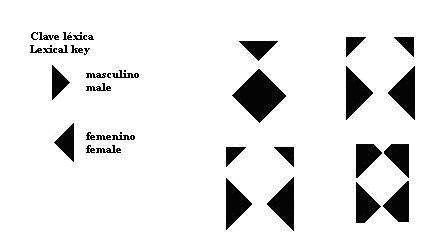 Semiotic Poem: LUIS ANGELO PINTO
 SOLID, going to space formulations, opens the door to later developed Semiotic Poem (1962) by himself Dias -Pino and, later, in 1964, São Paulo Decio Pignatari poets and Luis Angelo Pinto (1965). The Semiotic Poem replaces the meanings of words shapes. This will display the corresponding figures with significance set by a "key lexical" or "dictionary" of the proposed new visual language. Configurations or formations of figures are the poems to read.
The next step was to move from its privileged position to verbal language (as the only source of poetic expression) and allow all the languages \u200b\u200b(including verbal language, of course) could take the responsibility. Here too, the participation of the "reader" creative "is decisive. Note in this Poem Semiotic Neide Sá, belonging to the second stage of movement, in which the translator code elements define not only icons but also participate in Text:
 Semiotic Poem: NEIDA SA
 one hand indicated the linguistic code imposes some reading, but the reader, to manipulate and alter the orientation of the figures, also alters its significance and therefore the text. On the other hand we can see how certain expressions that have no place in the verbal language, as eg, the word "know", "flavor" and "see" that would give rise to the term "flavor do know" that no specific formulation in verbal language, do have a level of visual language. The meaning of the poem depends on the active participation the "reader."
POEM / PROCESS
By 1967 at the inception of the Epic / development process as natural quasi Semiotic Poem, such participation was officially incorporated range of formal proposals, with the name "version", ie the creation of the poem to the reader operating on the "matrix" or poem draft agreement to their repertoire of knowledge. The release comes as a solution to the consumption of the unique work (an expression of privileges) and allows the "reader" operate on the poem that he proposes creating for itself, different versions. The poet, now, just enough for him, the way architects, describing visually or verbally poem project leaving it to the "reader" to materialize.
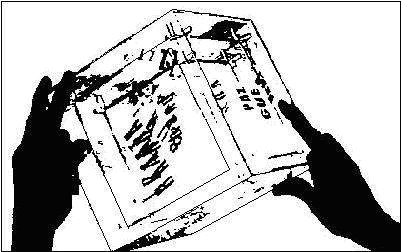 NEIDA SA: Transparencies
 Certainly, reading the "project" will generate the "versions" via participation of the "reader", according to materials available in every time and place particular. This frees the poet to "update" the poem without the fear that the new media, which necessarily will discover science and technology, might prevent its realization.
FOR POETRY AND / OR MAKE
These formal developments of Brazilian poetry edge could not fail to exert great influence in all spheres of art, poetry and related disciplines. So in Argentina, Edgardo Antonio Vigo, who, after speaking of the Poem / Process as a "poetry to build", ie, a poetry that requires the participation of the reader but following the outlines of a "programmer" or "projector process, "goes one step further by proposing a program that gives certain instructions (signals or tracks) to the reader and this, the real" constructor of the poem, "who will bring life to the poem. In his own words, "... the possibility of art is not only the participation of the observer but activation constructive. "(1970).
The new" reader "or" true creator "receives a modified project through creative participation. These ideas were embodied in the day on September 30, 1970 in University Hall the Republic, Montevideo, Uruguay, as part of the Vanguard Publishing Exhibition, which was the work of Edgardo Antonio Vigo "poem demagogues." Each participant was given a form with the project to be undertaken:
"Place, talking anonymity, a phrase, phoneme, symbol or visual (etc.) necessary for you in a poem in this space. Make a tube and insert it into the URN No. 1. Receive certification of the vote in the form of a card to be hanging from his lapel. Thanks "
Each participant, upon action on the white form, introduced in a special box with a round hole (not homer as the current polls). The day was completed with the work of Clemente Padin" Poetry must be made by everyone "in which participants acted on a blackboard which hung ribbons and white papers. Each one gave them a circular which stated:
" DIRECTIONS: Type in a verb blank ballot infinitive to express its need for action at this time. Then you nail in the sees fit, so that the verb is hidden by the ribbon. At the end of the poem, the organizers stick horizontally blank ballot so that it can be read, depending the color, and so will the pattern of concern at the collective level and plastic concrete poem, along with others, has contributed to create. "
It not only creates consumer actively according to the project but that does not individually depending on the version that deserves the solitary act of consumption but does so collectively. In the expectation of concrete and Visual Poetry through participation Poem / Process the creative construction of Poem-Making. Modification operating on the mode of artistic production and, consequently, the mode of consumption. "The most profound activation of the individual: the performance by him of the poem." The key proposal is about the modus operandi, the mode of production and consumption, not the work or product, which does not prevent it be altered unpredictably by the mode of production triggered (1971).
It is enlightening to note Vigo Expo / International Proposals to Perform at the Centre for Art and Communication (CAYC) Buenos Aires, Argentina, in 1971:
"The next June 18 will open this exhibition. All those present today whose history of having been made by artists from the field of visual or sound poetry. These two camps have been reactivated constantly searches performed internationally and have dropped (almost entirely) the treatment of poetic and visual level, as well as traditional venues, both in its presentation (exposure) and development (book .) Accumulated experiences and allow them the proposal.
At the time of the liberation of the camps in the traditional arts are divided into genera, but not advocate a total art, research POETIC remain within that field, it comes from all imponderable that indefinable "mysteries to unravel" as well as traits may notice a "contemporary romance" as defined in their form and conjugated differently. The exhibition has been organized by Edgardo Antonio Vigo, with the direct collaboration of Elena Pelli (Resistencia / Chaco) and Clemente Padin (Montevideo / Uruguay RO).
To maintain consistency within the presentations of projects and some of his works have started from the PROCESS / POETRY, movement in Brazil breaks the hegemony that until about 1969, kept the NOIGRANDES GROUP (concrete poetry) in San Pablo. The POETRY / process innovation brings the possibility of active participation of the observer, to those who provide "minimum key" you are welcome and encouraged to shape the final content of the poem partly or proposed. It also adds to this the possibility of a constant change of the result (by the intensification of public and individual participation), it becomes a "NUNCACABAR" of the poem. Later there is a movement across the world, where the poetic investigations are proposed but not realized. It
the possibility of exchanging ideas, concepts and projects and free of the poetic object (dear to the Surrealists with his variation POETRY / objectives and proposals for the first theoretical notes of poetry / process-Wlademir DIAS-PINE-) as the final outcome and necessary so far. The completion of planned work may be made by a wholly away from the developer or researcher. "
this fragment also note Edgardo Antonio Vigo (1971) describing his project A VISUAL WALK TO THE PLAZA RUBEN DARIO:
"A Card indicating a minimum key and an element (which may be substituted), invites us to perform an act that we can simply modify the other. Based on his reading, the realization of our own act. Explain: take a piece of chalk, mark a cross (or any other geometric center or not) within the center or around it to make a 360 º (which may be smaller or plural), add a variant on the horizon, we can change by standing on tiptoe or squatting (why not come down and support our body literally on the floor), with any of these possibilities and exercise You have made VISUAL WALK TO PLAZA RUBEN DARIO (designer : EAV, Buenos Aires, CAYC, 1970). The absence of the work, need not be present, the ephemera of the room, open to the possibility CONSOLIDATED ACTS dissimilar to those proposed makes us all into makers (read traditionally creator) of consumer situations and not typed a priori. "
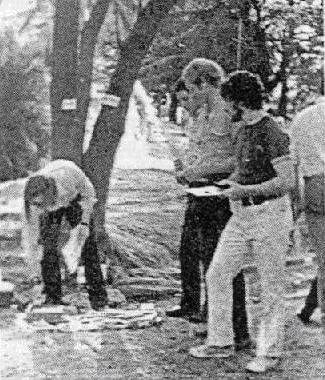 EDGARDO ANTONIO VIGO : "A Walk Along the visual Ruben Dario Plaza, Buenos Aires, 1970.
 POETRY INOBJETAL
Clemente Padin's ideas had already materialized in some works published in the magazine OVUM 10, as eg "Gastou, Gastou" and "In Hoc Signo Vinces" in which the reader was urged to act on the poems. Thus, by 1971, made a poetic action which he called Poetry Inobjetal. Please note that in those years (late 60s.) are attending a unanimous questioning the fundamentals of the language, particularly verbal language, which is considered a source of all information deformations via ideology, and another agent system for the subjugation and control of society. So it was not strange that this proposal Padín utopian attempt to set aside the language of "representation" characteristic of the verbal and other languages \u200b\u200bthat their meanings conventionally established by social consensus to propose a language of "action", signs "to act, to say. " That is, proposed to replace the signifiers for the actions and meanings for the consequences of action and senses awakened. Of course, the "makers of texts" in this particular language, for the sake of "doing" would be participating and while creating the "poem of action." The downside of this proposal, as he himself admitted it Padin (1975), is that, for there must be communication languages \u200b\u200band the "actions" had not been inventoried or conventionalized to the point that each of them you could attribute a meaning (except for a small number of which by custom have been given a sense as eg, giving flowers express "love", etc.). In addition, the "readings" of the actions modulated by the degree to which affected the interests of "readers" depending not only on the repertoire of each other, but their expectations social.
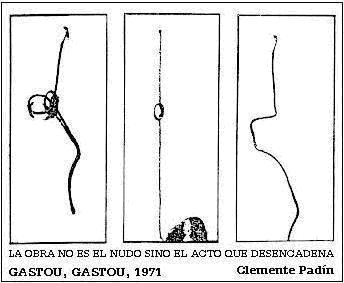 Clemente Padin "Gastou, Gastou" 1971.
 POESIA SONORA GESTURAL HYPERTEXT ASSEMBLY AND / OR MAKE
had to wait until 1996 to find "beyond" the proposals to the poetry of the participation of the 60s. we have discussed. The Argentine poet Fabio Doctorovich Paralengua Group of Buenos Aires, applying the dynamics of new media gives the "reader / active participant" to express themselves through different media: sound, gesture, movement, etc. , expanding registration of expressive possibilities. After recognizing the contributions of Vigo and Dias-Pino and analyze the monoconceptualidad of almost all of the poetic production of the century, ie strictly vehicular decoding a single channel by proposing the plurality of ways of expression, the Poem Multiconceptual, as is, moreover, it has assumed experimental poetry today to take advantage of all the dimensions of language, not only the semantic level but also the sound, the visual, performative, etc..
In his theoretical formulation, expressed Doctorovich (1998):
"An application of multi-tenant could be production works to work various components (textual, visual, sound, etc.) separate parts would join interrelated in the manner of a modular structure. Each module, unlike the multimedia or audio would not necessarily be represented simultaneously with others. This would give the character of a modular work "work to build" because the reader could arrange the modules in different sequences possible or add your own modules, creating a multiplicity of readings. In order to ensure that the work is a single (albeit divided) and not the mere sum of its parts, and to address one or more common topics, modules should have parts that work in the manner of interlocking pieces, being the most obvious example of this technique intertext in which the B module would be used phrases that would refer to the module A.
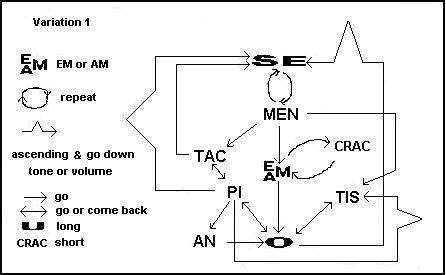 Doctorovich FABIO: Gesture / Hyper-textual poetry to Build and / or to Carry out 1.
 As we see, the poem is divided into components that depend on the dimension of language that is called (semantic, visual, aural, etc.).. The difficulty is how to bring back those modules into a single entity. In a poem the mooted verbal SOLUTIONS especially copulative conjunctions, in the visual poem, the space itself, in the phonic poem, time, etc. The proposed Doctorovich, the modules are "built" according to a "hypertext syntax (" hiperpostipográfica "as the flame). That is, viewers (inset) is not only meaningful but each module also articulated by the whole. Finally, the latest twist, the work itself ceases to be a permanent body, as:
original designer must take care to outline a plan (bi-, tri-, or n-dimensional) of the work to serve guide to future authors and also indicate the spaces fill (modules or pieces done.) Thus, the work becomes a dynamic entity, consisting of assembled parts that can be embedded or disengage a piacere. Also the concept of "artwork" would disappear because now we would be "a form metamorphic, jelly, a" blob ", consisting of real and virtual materials."
We are aware the influence of the newest media, especially computers, in the proposed Doctorovich. Adapt the expressive instruments while he lives is, without doubt, the challenge that poets never refuse. In addition, the media have always "contaminated" and influenced the forms. Therefore, technological advances, especially in the field of expression and communication, have always led to formal changes, either in the works themselves (adding an excess of information), whether in the pattern of consumption.
 Doctorovich FABIO: Gesture / Hyper-textual poetry to Build and / or to Carry out 2.
 CONCLUSION
Newest born from the old (O patently obvious guys!). Since "everything that will produce the human being can be art" of Duchamp's "everything that can be heard can be music" of the assertion Cage Beuys that "anyone can be an artist," everything comes together the great contribution of the historical vanguards, especially of Dadaism: "Art is life." And life is dialogue, communication is social production. In proposing the participation as being with the art and poetry, artists and poets do not do nothing but reaffirm that art premises free of their status as consumer goods or products exclusive and subject to the laws of the market. In proposing the final product liability "consumer-active, the artist does nothing to return art to its original social function, the area of" use "means a product (not necessarily material) expressing symbolically their urges and needs ("Poetry must be made by all" the Count of Lautreamont). Participation has been the seamless thread that united every poem and every proposal of Latin American poetry in the second half of the twentieth century and, indeed, new media, especially electronic, they will do nothing but encourage interaction through they make possible.
Bibliography consulted
Cirne, MOACY Vanguarda: a semiological Projeto, Vozes, Petropolis, Brazil, 1975
DE SA, ALVARO Vanguard: Produto de Comunicação, Vozes, Petropolis, Brazil, 1977
DIAS-PINO, Wlademir A Ave, Ed Igrejinha, Cuiabá, Brazil, 1956. ----------------------------------
Solida, author Ed, Rio de Janeiro, Brazil, 1962. ----------------------------------
Processo: Linguagem e Comunicação, Vozes, Petropolis, Brazil, 1971.
Doctorovich FABIO ENCAszTERS in catalog VI International Biennial of Experimental Poetry, Section Cono Sur Latinoamericano, Montevideo, Uruguay, 1998.
ECO, UMBERTO Open Work, Planeta-Agostini, Madrid, Spain, 1984 FERREIRA-gull
Nao-Object Theory in supplement of Jornal do Brasil, Rio de Janeiro, Brazil, 1959.
PADIN, Clement of the Representation al'Action, Ed Polaire, Marseille, France, 1975.
Pignatari, Interview DECI Correio da Manha, August 21, 1965.
Pignatari, Deci and Augusto and Haroldo de Campos Pilot Plan for Concrete Poetry. In Noigrandes magazine, nr. 2, Sao Paulo, Brazil, 1958.
VIGO, EDGARDO ANTONIO Of Poetry / Process to Poetry for and / or Perform, Diagonal Cero, La Plata, Argentina, 1970. ---------------------------------------
Street: current art scene, magazine OVUM 10, no. 6.1971, Montevideo, Uruguay.
* Article published with permission of the author.


0 comments:
Post a Comment