Monday, December 19, 2005

Wedding Programs Flowers In Memory

poetry "or not to participate ...? Postmodernity

Zeal for festivals, events and competitions are a clear symptom of social explosion. Alongside these are projects that posit sediments onal culture born, as was the Fotoencuentro 2005, the opening of the museum of photography. First museum dedicated to the art in Bolivia. These projects as or more important as the frameworks within which they subscribe, are the layers of the country's cultural sphere.

Most festivals and have been promoted and realized by private initiative. Establishing itself as the most important for his career and participatory and organizational: the International Festival of Renaissance and Baroque Music "Misiones de Chiquitos" (Santa Cruz), Luz Mila Patino Festival, the International Festival of Culture (Sucre-Potosí), the International Theatre Festival (La Paz), the Ibero-American Film Festival (Santa Cruz), and under another name we say, but equally relevant : Fiesta del Gran Poder (La Paz) Oruro Carnival.

competitions form a cell that is directly linked to festivals. Either because many are designed to enter a contest or because the latter is worth the convening power of the festivals.
Among the oldest are: the Annual Hall Pedro Domingo Murillo (1953), the National Culture Award (1969) and Luz Mila Patino Festival (1971).

However, an explosion happened in the '90s. From 1993 until now, the stream of festivals and inaugurate a search variable calls for participation and cultural openness. Let

the border as a trench to move to the border of the exchange became a vital necessity for the development of culture.

Thus, in recent years, the cultural scene was favored by the National Poetry Award "Yolanda Bedregal" and the National Competition of Contemporary Art (Conarte) that carry about four years to encourage the writing and the arts visual, respectively.

Huari Some private companies and Petrobras have recently established a new space of engagement through awards for the visual arts and films.

Finally, fairs (eg the book fair) and cultural encounters, achieve a particular level of integration of the arts. And become an important national cultural market thermometer.

Whereas in the past six years were set up about half of the festivals and competitions that take place today, it's easy to say that bodes well ahead if the artistic level of participation (both in quantity and quality ) consolidates the two events.
NATIONAL COMPETITIONS
National Poetry Award "Yolanda Bedregal" - Summons the Vice Minister of Culture and has sponsored by Plural Publishing and family Conitzer Bedregal. Closes in October each year. The award consists of a medal, cash and publication of the work.
Premio Nacional de Novela - Summons the Ministry of Economic Development through the Vice Ministry of Culture. It is sponsored by Ediciones Santillana, AFP Previsión BBV-SA and Grupo Prisa. The annual award consists of u $ s 8,000 and publication of the novel with the seal Alfaguara.
Franz Tamayo Short Story Award - Summons the Administrative Office of Culture (La Paz). Rewards the best stories nationwide. Until 2003 was supported by Ediciones Santillana.
Siart. International Biennial - Summons the Vice Minister of Culture, the Latin Union, the National Academy of Fine Arts "Hernando Siles" and the National Art Museum. As part of this meeting is given Entel Prize, the Nobel Union America, the Europe Prize. The call usually closes in June this year it is made (usually odd years).
Conarte - Summons H. Municipal Government of the city of Cochabamba, the Administrative Office of Culture and no organization is in charge of the group swam This meeting has a deadline of June, and takes place biennially. The next year, 2006, will have a new dynamic of participation and development. Call was launched in January.
Salon Pedro Murillo - Summons Administrative Office of Culture (La Paz). Is awarded a grand prize of Bs 25,000 and Bs 10,000 three awards for to different techniques.

www.cultura.gov.bo
Yellow Green Checkered Vans


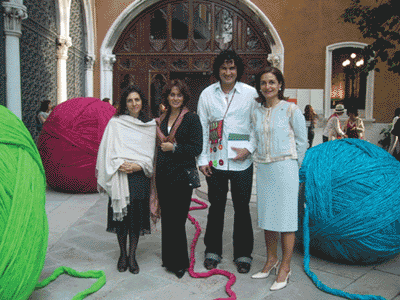
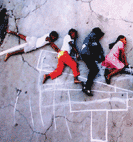
Guiomar Mesa, Cecilia Baya, Joaquín Sánchez and Ms. Estenssoro. Works: Robin Rhode (Cape Town), Joana Vasconcelos (France) and Mark Wallinger (UK).


The Venice Biennale (Italy) and the Biennale of Mercosur (Brazil) were two of the important instances where the national contemporary art showed its best side.

VENICE

The 51st. Venice Biennale held in 2005, 110 years since, in 1895, the public attended the first International Art Exhibition.

From 12 June to 6 November was held this traditional biennial, organized by the Fondazione La Biennale di Venezia and the English led by Maria de Corral and Rosa Martínez (yes, two women were in charge of this work for the first time in the history of the Biennale.)

Consequence: two exhibitions of art characterized the review. One under the direction of poultry in the Giardini of the Biennale, which explored the art trends from the past few years getting to this, the other mounted by Martinez at the Arsenale, which looked at the near future, trends new scenarios are emerging.

David Croff, President of the Organising Foundation, said the enthusiasm with which the coun-tries have come to participate, coming with a record number of units (73) and several debuts.

Bolivia participates in Venice since the 60s. Have gone through the international scene of artists such as Marina Nuñez Prado, Sol Mateo, Gastón Ugalde, Ricardo Pérez Alcalá and Raul Lara, among others. The Deputy Minister of Culture of the Republic instructed the degree Cecilia Berry, who serves as national art curator for several years, the task of selecting the artists who participated in Venice.

Bayá for the selection of artists, took into account "the contemporary nature of the work and the issues raised by the general curator." Search for "artists that have a quality work and excellence in content and aesthetics that allows reading and mega visibility of this nature."

"Balls" by Joaquin Sánchez (Paraguay, 1975), results in three areas of wool from two meters in diameter, connected to earth by its ends. Giomar

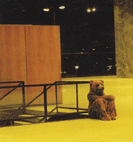
Mesa (Bolivia, 1961), left the canvas and using as a medium "water clubs" sensual and stylized painted figures. In an intimate movement of logs was the beginning of a suggestive dance that attracted feelings.

The works were displayed at the Istituto Italo-Latino-American Love. They also exhibited the work of artists from Chile, Colombia, Costa Rica, Cuba, El Salvador, Guatemala, Haiti, Panama, Paraguay, Peru and Dominican Republic.
"no fault" by Joaquin Sanchez, "Sancta sanctorum" of Alejandra Andrade, "Illusion" Rachel Schwartz and "Olive green "Narda Alvarado.

MERCOSUR

September 30 to December 4 will be held in the city of Porto Alegre (Brazil) a new version of the Mercosul Biennial . This edition brings together 173 artists from Argentina, Bolivia, Brazil, Chile, Mexico, Paraguay and Uruguay. Stories

art and space, was selected as a reference to review by the curatorship by Paulo Duarte (1943, Brazil). The international curators were: Eva Grins-stein (Argentina), Cecilia Baya (Bolivia), Justo Pastor Mellado (Chile), Felipe Ehrenberg (Mexico), Ticio Escobar (Paraguay) and Gabriel Peluffo Linari (Uruguay).

Unlike previous editions, the distribution of artists defies the political and geographical boundaries. The sample consists of four main areas: "In the sculpture installation," Transformations space "," Directions of new "and" The persistence of painting. "According to Duarte, these vectors thematic foster the viewer the possibility of differences vis-fire and the cross between the works.

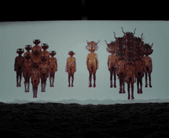
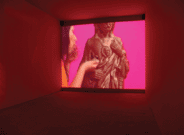
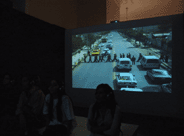
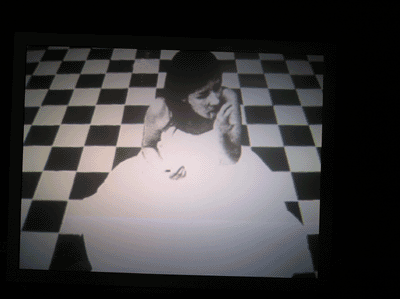
artists who represented the country are: Maria Luisa Pacheco (La Paz, 1919-1982) with ten paintings in oils and mixed media. Alejandra Andrade (La Paz, 1977) presented "Sancta Sanctorum", video installation of four pictures chocolate casts of saints, and a 5x4 meter screen which depicts a scene in which she exercised an act of "cannibalism" to his work. Raquel Schwartz (La Paz, 1963) "Illusion" is a two-story facility, with its furniture and utensils covered with plush pink. Appeals to the senses and reflects on the current values. Joaquín Sánchez (Paraguay, 1975) made "no fault", video installation. Moving images are projected onto a series of photographs of naked bodies in two groups, men and women, and a central couple, they all have masks Diablada. The sound is a composition made for this work. Sol Mateo (La Paz) multimedia installation which raises confront the viewer with a very sensitive issue faced by the Bolivian society: child abuse. The images, taken from the air television, merge with each other to give meaning to the idea. Marcelo Callaú (Santa Cruz, 1946-2004) a tribute to this artist booked Santa Cruz, which became known as his last work, a packet of four inch perfect wood carving. Patricio Crooker (U.S., 1975) photographer by profession, presented six backlights of landscapes taken at low speed and movement. The figures generated images abstract aesthetic. Narda Alvarado (La Paz, 1975) with two performance videos: "Olive green" where we see a group of police traffic stop to eat an olive green, and "From the Atlantic Love ", recorded an official act promoted by the artist who hand over a bucket of seawater to the Bolivian Navy.

This time Bayá prioritized new technologies such as exhibition stands, and brought together eight artists of varying aesthetic orientation and generation.
Photo: Catalog 51. international art exhibition. Bayá Cecilia.
Marcia Lozano

Tamil Words For Marriage

international biennials in the heart of South America to cure the trade

production of visual arts in Bolivia in recent years has become eclectic, not a trend that can be identified, in contrast with Doras homogenized global trends of this age, in which blunt existential concerns.
was working in a multicultural art relating, belonging, at the same time possess universal qualities, where a Frenchman, a Brazilian or German intellectually or emotionally may be interested in the work, find qualities that can flow in other contexts.
complex cultural fabric in which we operate shifts the need to have a national identity to bring awareness of many identities, and characteristics of this contemporary, without losing our characteristics, without losing their own characteristics and the desire to remain us themselves, individuals and authentic. Bolivian
creators are not likely to manifest itself through an intangible art, perhaps due to socioeconomic and cultural reasons. It is possible that one reason is the importance given to human relationships, that still retain group rituals and customs that deal with existential and transcendental values \u200b\u200bto small companies with strong family structures, customs physical contact, to feel that need for materiality.


In a paper entitled "Postmodernism in the heart of South America", Cecilia Bayá Botti (Bolivia). Text published in the book "Rosa-dos-Ventos" Posições e Na Contemporary Art Director. Fudanción Mercosul Biennial. 2005.

Peeing Alot And Being Tired


Garavito * Ramiro Collaboration for hartus .

For many people the term "curator" has yet enigmatic meaning when it is mentioned in art, and even more so in the artistic context of Bolivia.
could say that the curator was in principle, someone who looked after in a more or less broad, exhibitions in museums. Then, with the appearance of new works of art proposed by the early avant-garde, the relationships between artistic practice and the public become more complex and less traditional, generating new ways of communicating, new features, new offices, and museums are forced to modify the terms and conceptual space to "save" and art show and emerged as the modern museum major fracture in the history of museology.
The curator appears as specialized intermediaries and institutional guidance will allow a relationship not only between the expectations of the people and works of art, but also between cultural institutions and artistic production.
The curators are present, the most influential architects of the interpretation and analysis of contemporary art production line, enabling a coherent reading and guidance which includes the design of exhibitions and the establishment of guiding principles for the formation of institutional libraries, corporations and private.
In short, health and the fate of the visual arts seem to have been entrusted to the curatorial criteria, as these are the ones that legitimize and reinforce the value of the artwork and also produce cultural meaning.


Four views of curators recognized discharged from the practice of curatorial: Ivo Mosque (Brazil): "The curator is a professional who collects pieces, fragments new worlds, which includes parts of private universes ... significant that organizes groups of disordered, setting directions and markers to make maps of contemporary art ... reveals no sense, but creates it. "Andreas Huyssen (Germany):" Heal, today, means mobilizing collections, moving them within the walls of the museum ... as well as the heads of the spectators. "
Achille Bonito Oliva (Italy): the healer" ... facing a new class of non-specialists, instant, intercultural, transnational. This is where the curator or curatorial activity was taken as a translation, retrofitting specialized content ".
María Luz Cárdenas (Venezuela):" A conservator is a person under whose responsibility is the care of exhibitions and collections. Is the one who serves, directs, and conducts its guidelines define theoretical, conceptual and ideological, and who ensures consistency, clarity and definition visual assembly.


In Bolivia, the office of curator is not institutionally established. The few people who work as curators do so casual and almost outside the official institutions. This is, of course, in relation to particular artistic development that has occurred in our country.
As in most Latin American countries assumed the artistic practice of the modern changes in Bolivia, were still in force in general, academic concepts of nineteenth century Europe.
Consequently, there was no need to change, no spaces or concepts museum or museums.
Only in recent years, due to phenomena of integration and commitment to the international art community curatorial duties have been improvised situational specific.
There are clear indications that this will change, which no doubt has to do with the process of transition which Bolivian art of Indeed, I Contemporary Art Contest sponsored by the city of Cochabamba had a curator for the first time in the history of art competitions in Bolivia. Also, the biennial International Exhibition of Art (SIART) based in La Paz, provides curatorial assistance, but still no museum, cultural institution or gallery, is on the ground of their staff to the official curator.
The importance of the figure of the curator is undoubtedly connected with the specific characteristics of contemporary art in its relationship with the world.
time would be appropriate to assimilate what happens outside our borders, and analyze usually involves risks currently held by the conservator. While
are healers who often articulate new ways of understanding contemporary art, the artists who created and revolutionized the sensitivity patterns. This method requires an ongoing dialogue that involves defining the role of each. On the other hand, it is necessary to establish a boundary between the exhibitions in which the works become objects of a facility, under the idea of \u200b\u200bthe curator-and those exhibitions where the presence of the healer is dissolved allowing each artist and his work can assessed individually.

* Artist and teacher in art history.

Antique Orange Squezer

art curating and cultural management worshop


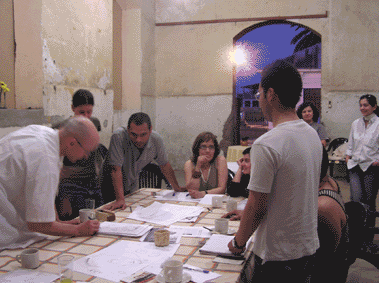
Harm Lux (left), curator in charge of the workshop, along with participants.

Artists, art historians and journalists attended the workshop which was held under the organization of CONARTE / off, 12 to 18 November in Cochabamba.

Harm Lux (Netherlands), international independent curator and teacher at the Amsterdam Rijksakademie was the guardian of the workshop which was sponsored by the Embassy of the Federal Republic Germany and the support of the Global Development and Dialogue of Cultures.

The workshop is the project number 32 that made the conartprocess since it began operations in 2002.

The workshop covered aspects related to space, time, matter, object to the ideas of these shows and staging. The concept of curator is something quite new in our environment. The task of the paper is essential to ensure consistency and cohesion to the exhibitions.

Carnauba Wax Molecule

what to do with a bunch of early?

Jorge B. Collaboration Rodríguez *
to hartus
.

In his Introduction to artistic creativity , Professor Juan Acha says that after twelve years of age, adolescents develop their vocation for the arts. Referring to Latin America, denounced the ineffectiveness of governments to provide institutional alternatives that contribute to the vocational maturity of young people, and how those who show an interest in addressing these issues favor the residual modes of production, distribution and consumption of art and obviate emerging.
According to this view, projects training art directed at adolescents, narrow-mindedness prevails, incompetence and conservatism:
(...), students do not know the possibilities that society offers to choose art as a profession or considered as a mere hobby, to conceptualize creation according to their interests and to select the genre and trend that suits you. (Acha, 1992. 56). According
Vygotsky in the visual arts, creative vocation matures around 14 years, but in Giotto expressed as early as 10 years, such as Van Dyck, in Rafael at eight, as in Gros, Miguel Ángel at 13, in Durer at 15, in the twelve Bernini in Rubens Jordanes and also very soon. (1987.47)
So while that erupts when a strong vocation is not strictly defined, it often crystallizes, more or less in the age before us.
is a real feat that some of them persist in certain arts and evidencing practice their unique talents despite the neglect of the social environment. This miracle undertakes the training system with the establishment of places where early artistic talent, so delicate and unusual such as sports or science, can reach the ultimate fulfillment: an open and malleable.
In our experience, the implementation of projects educational competition designed to develop artistic and gifted young professional requires, among other require-ments, a thorough understanding of the unique features of cognitive processes within these specialties. In this context, the evolutionary approach and the historical-cultural can provide a framework for reflection.
Piaget is presented as a supporter of acculturation or "development." Considers the child's intellect is in an unstable point, uneven, with respect to the universe of objects and experiences that surround it. The teacher's role is limited to create learning situations that mediate between the level of reasoning reached by the child and could achieve.
Meanwhile, Vigotski located at the heart of intellectual growth in the ability to learn from instruction. His concept of zone of proximal development refers to the difference between what the child can do without help and that of which potentially would be able after receiving appropriate guidance, the actions seem to exhibit greater adult attention and importance in Piaget. (Op. cit., P. 175 and 176)
evolutionary currents agree on the establishment of a first phase in which images are generated "the child into the world" and a second in which the child enters their achievements "what you see." In adolescence, all report a decrease in artistic activity. Development
These pictures are, if anything, a clear value instrumentally: they allow us to distinguish potentially effective starting point in any artistic and educational exploration.
The aforementioned decline in artistic activity from 12-13 years is more an outgrowth of educational systems are imperfect, but a consequence of mutations characteristic of this phase. They questioned the theories that blamed on biogenetic causes adaptive difficulties often occur in very specific cultural contexts, during that period.
In our field, the issue acquires a peculiar bias. When comes the period of operations formal logical-the words of Piaget, in the intellectual sphere many changes occur, distinctive for its diversity and the relative speed with which they occur. But on an artistic level not produce a linear and upward as the one looming on the intellectual area.
The advent of various qualitative reasoning skills, brings about a sharpening of the critical capabilities that cripple the development of artistic creativity which, under optical circumstances, reaches a peak in adolescence.
vigotskiano approach emphasizes that this cooling of the teenager in connection with the drawing flap over the expression graphic to a new level of evolution, to which access is encouraged only if at school or at home.
seems reasonable to conclude then that the options to stave off discouragement to the art that usually affects adolescents, must be articulated in the previous stage. Gardner argues that the key lies in how we approach the challenge educa-tive of literal years:
A key factor is to achieve a certain competence to reach adolescence because during this period young people are faced directly with the entire range of alternatives for each art form, (...) If his own works are well below this standard, it is likely that discouraged and give up their whole artistic activity. If, however, young people have gained over the years preteens enough skill to their jobs, "pass the test" is in place the ability to devote more time, perhaps a lifetime, to the arts. (1987.123)
At this point, one might ask how then address the artistic training of young gifted?
share the view that at this age, the decision whether to participate in training activities within a particular specialty is not for teachers or parents, but ultimately the student touches choose them freely, according to their own interests and hobbies:
... The drawing may not be massive and general occupation for all children in the age of transition, but (...) is drawing huge cultural value, when (...) the color and design begin to speak the adolescent acquires this is a new language that will broaden their horizons, deepen your feelings and to express images that otherwise might have come to consciousness. (Vygotsky, 1987, 103)
The eminent Russian psychologist stressed two issues with the drawing at the age of transition. The first is that the adolescent has not had enough of the spontaneous artistic expression activities, needs to acquire habits and knowledge of art professionals.
only helping to assimilate these materials can rightly railroaded drawing development of children in this age. (...) On the one hand we must cultivate the invention, on the other hand, the process of representation of the images created by the imagination requires special knowledge. (P. 104)
Here unfolds before us a question which has been discussed: the proper way to enter training practices that articulate, obviously, subject to certain rules.
not trying to discover the precise dose of technical procedures and imaginative exercises that should be mixed in the container called Plan and Study programs. In this way would achieve just resultancias eclectic inaccurate since its edge to his heart that inherently would leave intact the core problem and undisputed: the nature of such rules, the conception of art to which they respond.
access to materials, techniques and procedures, highly recommended, it is essential. What it means in terms of extensive enlargement of the reference field, and because your child may be deciding his expression to those resources that are most closely related, those through which you can see encouraging results.

* Professor Art. School of Arts and Crafts in Santa Cruz, Puerta Abierta.Universidad Nur Foundation

When Your On Iron Tablets Can Your Poo Be Black

siart - international art biennial - 2005

The International Art Exhibition (SIART) began performing in 1999, with the headquarters in La Paz. The purpose of the room, that from this fourth version is called biennial artists is that Bolivians have the opportunity to "participate" in an international event.
During 2001 and 2003 were carried out, with political problems through-the successive versions.
Unable to escape his slump, this fourth version was marred by the political scene, running date for receipt of projects, works and subsequent inauguration.
The contest was divided into three levels: presentation of honor, retrospective and competition. And since 2001 has the "Prix Europe" Youth Art Contest, young artists for Bolivia (under 25). Siart
This year, as all international biennial, aimed to bring art into urban spaces. Under the heading "urban beats" that artists sought to develop their work within the urban language.
For the selection of projects was considered as those that responded to the character and content of the Biennale.
The jury, composed by: Corentin Haml (France), Karsten Konrad (Germany), Carlos Palma (Peru), Miguel Gonzalez (Colombia) and Ramiro Garavito (Bolivia) awarded Douglas Rodrigo Rada (Bolivia), Latin Union Grand Prix for his work "Ball ", video installation.

Also

were distinguished: the Prix Holland, 9427219 cm, Keiko Gonzalez and Patricio Crooker (Bolivia-USA), with Prize Entel, Untitled, Carlos Borges (Brazil), the Integration Award, Conversarion, Catch the Thief and 123456789, Tamara Jelacica (Serbia).
The National Youth Art Contest winners were: Alejandra Delgado (La Paz) and Roberto Unterladsaetter (Santa Cruz).

Solution For Nadi Dosh In Kundli


l E international artists workshop Km 0 urban held from 14 to 27 in City of Santa Cruz de la Sierra. Km 0
Urban is the second version of the network of international workshops Triangle Art Trust which takes place in Bolivia.
The meeting was supported by the Art Triangle Foundation Trust (England), sponsored by the Fundación HIVOS (Netherlands) and the Prince Claus Fund (Netherlands). At the same time, with the support of the municipal government, Prefecture, the Franco German and other national and international cultural organizations.
development workshop, which brought together 25 artists, focused on the Art Museum, and had the common philosophy with the practice exchange.
attended the meeting: Cecilia Lampo, Marcia Lozano, artistic group identity variable (Alejandra Andrade, Alejandro Archon and Avril Filomeno), Robert Lanza, Keiko Gonzalez, Juan Pablo Arce, Camila Molina, Ramiro Roach, Roberto Unterladstaetter, Alfredo Román, Raquel Schwartz and Douglas Rodrigo Rada of Bolivia.
Among the international guests were: Asa Elzen (Switzerland), Emilio Santisteban (Peru) Meirana Sergio (Uruguay), Tamara Holy Spirit (Brazil), Olof Bjornsdottir (UK-Isalandia), Karsten Konrad (Germany), Mariano Molina (Argentina), Esteban Garcia (Colombia), Ricardo Rendon (Mexico), Marietta Davis (USA) Wen Yau (Hong Kong), Chuh Chiu (Taiwan), Ismary Cabrera (Cuba), Luis Romero (Venezuela).
As part of the workshop were a series of lectures by leading international curators as Titius Escobar (Paraguay), Lizbeth Rebollo Gonçalves (Brazil), Eva Grinstein (Argentina), Harm Lux (Germany), Alessio Antoniolli (UK) Cecilia Baya (Bolivia) and Angelika Heckl (Bolivia).

Mens Speed Suits Cheap

read - read - read

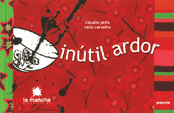
Claudia Peña - Valia Carvalho
WASTE BURNING
La Mancha Editorial
Sorry men. A book purely feminine. Transmute the look of genres, from the love of the loving couple to be alone. The character and poetic prose has flashes slides of helplessness and desire.


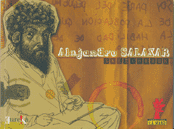
Alejandro Salazar
SKETCHBOOK
Editorial Eureka
As notebook log, each page of this issue reveals the wit and humor of its author. Cochabamba artist based in La Paz, has remarkable and perhaps little known graphic works and paintings. Make illustrations for newspapers and painted with enviable creativity and productivity.


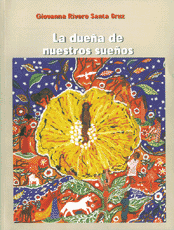
Giovanni Rivero
THE OWNER OF OUR DREAMS
Fundarte - Correveidile
A book that view life from Santa Cruz the periphery, where nature forms and forms a strong life experience. The authenticity of the text that has a lot of poetry, leave room to imagine a simple context that bears witness to the cultural and social differences.